
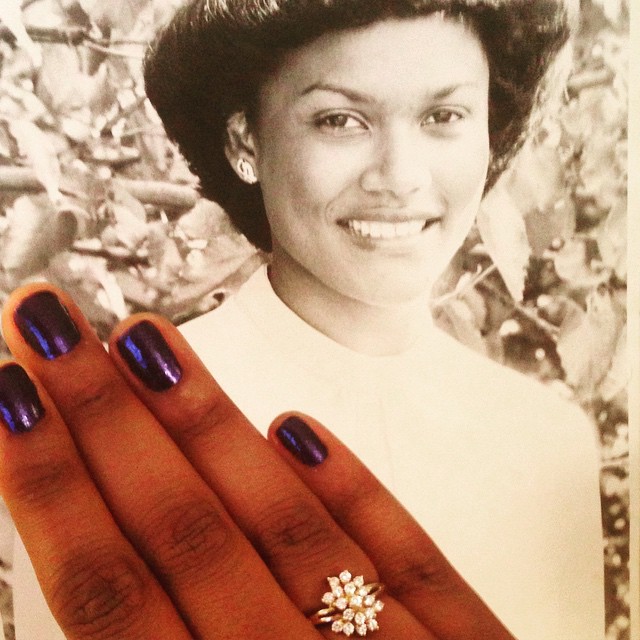
As a child, preparing for Mother’s Day was one of my favorite things to do. At home, my father would masterfully and secretly devise plans and surprises with us for my mother, and at school, my art teacher would give the blueprints for what I felt were the most creative and beautiful things a girl could give to her mom. Each year, my art projects evolved; non-sensical scribbles became neatly colored drawings, with a sloppily written “I love you”, and ultimately turned into painted birdhouses, plastic beaded jewelry, and other juvenile masterpieces.
My teenaged self, beginning to take on my mother’s knack for card-writing, would painstakingly select an equally mushy and funny card, and fill it with clever expressions of adoration. The big sister role that I took very seriously also compelled me to orchestrate a presentation of gifts from my younger siblings, in order of age, either before or after dinner. It was their turn to share scribbles, and birdhouses, and glittery purple bracelets that would be worn with a slight cringe by my mom, who like many other mothers, had mastered the art of feigned awe and adoration at the crappy creations of her children.
When in college, and distracted by the shimmer of freedom and pseudo-adulthood, I began to subconsciously rely on the bombardment of commercialism to remind me that Mother’s Day was coming soon. I’d drop a card in the mail, and make a note in my planner–and as time progressed, my phone–to be sure to call.
The day took on a different feeling when in 2008, while I was still in school, my mother was diagnosed with early-onset Alzheimer’s, one month before Mother’s Day. When I called that year, we willfully avoided the topic, and instead exchanged jokes and jabs that had come to be a large part of a mother/daughter relationship that in my adulthood, had also developed into a friendship. I’d often jokingly greet her by her first name, or say “Hey girl!” as if I was talking to a peer. She’d half-heartedly chastise me by saying my name in a way that I can often hear perfectly clearly in my head.
When my family was in town in 2010, one week before Mother’s Day, I gave her her card early. Inside I’d written my very best sap-filled musings of gratitude and love. After I’d seen them off and they’d hit the road, I went back up to my apartment and realized that she’d forgotten it on the kitchen counter. It was a simple act, that could have even occurred had she been well, but it brought me to tears, and elicited a fear of loss that I wasn’t even aware I was capable of having.
The final three Mother’s Days I celebrated with my mom are a slightly suppressed blur, often overshadowed by the weight of her constant decline, and her near complete inability to speak or understand her surroundings. I most vividly remember that in 2012, she had a seizure Mother’s Day morning that rendered her unconscious for nearly 30 minutes. Those last three Sundays were incredibly difficult, as it was easy to call to mind memories and moments worth celebrating, but hard to deal with the gravity of celebrating a mother who would soon be lost.
This week has been one of the hardest I’ve experienced since my mother’s passing. The “Mother’s Day season” inundation that I once relied upon as a reminder has essentially been the bane of my existence, daily. TV ads and constant emails remind me not to miss out on sales, so that I can buy a nice gift for the mom who’s given me everything. A bombardment of balloons, flowers, and cards meet me at Walmart as I make a quick grocery run. Today, I found myself tearing up at a buy-one-get-one Starbucks offer that encouraged patrons to bring their mothers in for coffee.
As much as it hurts that I’ll never have my mother with me for another Mother’s Day, I’m grateful for the 25 of which I was blessed to be a part, and the 25 years that I had the pleasure of being loved by a woman unmatched by any other.
Even in her illness and lack of awareness, my mother’s spirit remained. She constantly wore a smile; the hospice nurses frequently told me that at a certain point, most Alzheimer’s patients lacked any sort of facial expression, and they’d never seen someone reach such late stages of the illness, but continue to be physically capable of smiling and laughing. She found unique ways of expressing her affection, often in the incredibly simple act of reaching out her hand to hold mine. There were times she’d see myself or my siblings cry, and though she couldn’t ask us why, or comfort us, she’d start to cry too, because somewhere inside her, she still couldn’t stand to see her babies hurting.
I can only hope to be one tenth of the kind, selfless, loving, and sweet-spirited woman that she was. Each day, I come to find more and more how much I take after her…guess I’m off to a good start.